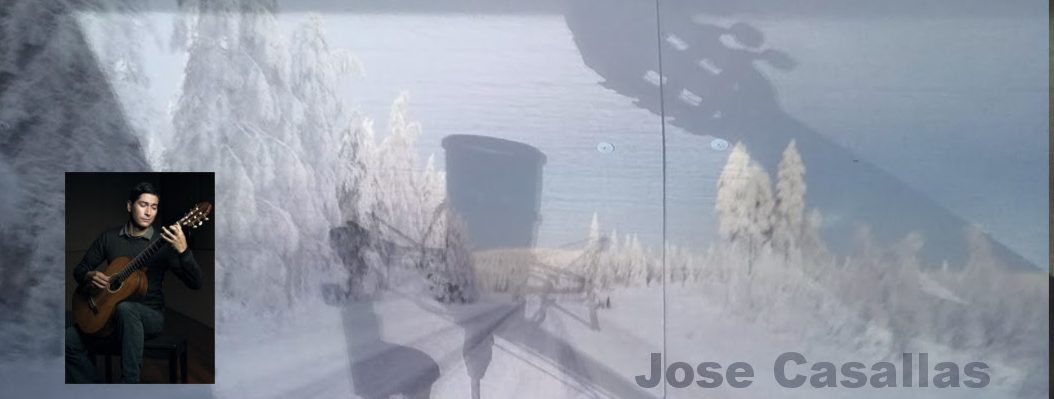
In this album “Danzando” you are invited to experience the close relationship between folklore and academic music; creating a imagined world of sounds that transports one through their mindscape of Colombia. Like a small hummingbird that flies from flower to flower, we are taken from dance to dance by the different melodies of Colombian music, in which we can enjoy the popular and academic music brought to same level.
Jose Casallas, guitar
Eva Sarkola, flute
Rody van Gemert, guitar
Guitar music by Graham Lynch
I have always been drawn to the guitar, an instrument capable of so many moods and, more than many others, a possessor of a ‘soul’, a mercurial personality. Although the poet Lorca rightly remarked that the guitar ‘makes dreams weep’, this instrument is possessed by such an unusual and restless spirit that it is equally capable of gaiety and joy, so that darkness and light co-exist within it. Like other plucked instruments such as the harpsichord, the guitar moves effortlessly into the lower registers without any loss of clarity, ruminating in its shadowy depths whilst throwing out higher notes and harmonics that hang above the aural darkness like starlight. It’s these qualities of chiaroscuro that I’ve tried to exploit throughout this recording, from duos to quintet, whilst layering the sounds and voicing the chords in a fashion that gives each piece an individual character.
As a composer, I admire artists who I see as magicians of time and place, creators whose sense of time is fluid, who play with the illusory nature of everyday life. These might include the likes of Jean Cocteau, Antoine Watteau, Gerard de Nerval, and Denis Diderot, and in their work reality and dream, light and darkness, intermingle in curious ways. Their influence on my music can be heard throughout this recording, especially in passages where rapid mood changes and sudden structural shifts occur; pieces such as Waltz Cocteau demand an uncanny performance precision to pull them off. In Dark Sonata the challenge is an opposite one, in that the dramatic narrative of the work journeys from the first movement’s calm opening notes through to the brutal chords that end the piece. And if the music of Naïvement Rondeau and Figures from Watteau is at times slightly enigmatic and mysterious, there can be no doubting the light-hearted element of Serenata Notturna and Pajaros del Mar. In this music, light and dark can be both an auditory quality as well an emotional experience.
For many composers the guitar remains something of a mystery, and is one of the hardest instruments to write well for, given the intricate possibilities for finger positions. Although I only dabbled with the guitar as a teenager, and have no real knowledge of the instrument, I composed a long and complex guitar piece many years ago, Apollo Toccate (2005), which sat on a shelf for a few years until I came into contact with Rody van Gemert. Much to my surprise and delight, Rody took this piece on, collaborated with me in extensively revising the music, and gave it its premiere, before subsequently recording it on the CD Ancient Greece, Musical Inspirations. Since then, I have written many solo and ensemble guitar works and Rody, and more recently Jose, has helped me bring these pieces to life. Without their detailed insights, suggestions and corrections, and endless patience, these pieces would never have seen the light of day. I’m deeply grateful to them, as well as to Mari Mäntylä, Antti Ignatius, and Petri Kumela, for presenting these works in such outstanding performances.
Graham Lynch
 JOSE CASALLAS